
The CSM is designed so that at initial recognition it represents any positive excess of the present value of expected premiums over expected claims, expenses and the risk adjustment (ie it's an estimate of the future profit).
Paragraphs 44 and 45 of the IFRS 17 standard detail how to roll the CSM forward from one point in time to another.
IFRS17.44 sets out how the CSM at the end of a reporting period is calculated for contracts without direct participation features, starting with the CSM at the start of the reporting period:
"For insurance contracts without direct participation features, the carrying amount of the contractual service margin of a group of contracts at the end of the reporting period equals the carrying amount at the start of the reporting period adjusted for:
Whilst for groups being valued under the General Measurement Model only changes in non-financial assumptions are absorbed by the CSM, for groups being valued under the Variable Fee Approach (ie with direct participation features) the impact on fulfilment cash flows of changes in non-financial AND financial assumptions are absorbed by the CSM.
IFRS17.45 sets out how the CSM at the end of a reporting period is calculated for contracts without direct participation features, starting with the CSM at the start of the reporting period:
"For insurance contracts with direct participation features (see paragraphs B101-B118), the carrying amount of the contractual service margin of a group of contracts at the end of the reporting period equals the carrying amount at the start of the reporting period adjusted for the amounts specified in subparagraphs (a)-(e) below. An entity is not required to identify these adjustments separately. Instead, a combined amount may be determined for some, or all, of the adjustments. The adjustments are:
As expected, we can see that the starting CSM for Aviva, 6,463m is the same as the closing CSM for 2022:
Aviva add the CSM to the risk adjustment to get a measure of what they call "stock of future profit".

The CSM for the VFA business is directly impacted by market movements (ie they're absorbed by the CSM), the release to profit of which is smoothed via coverage units release. For the GMM business, the difference between actual and expected investment return is recognised in the non-operating result.
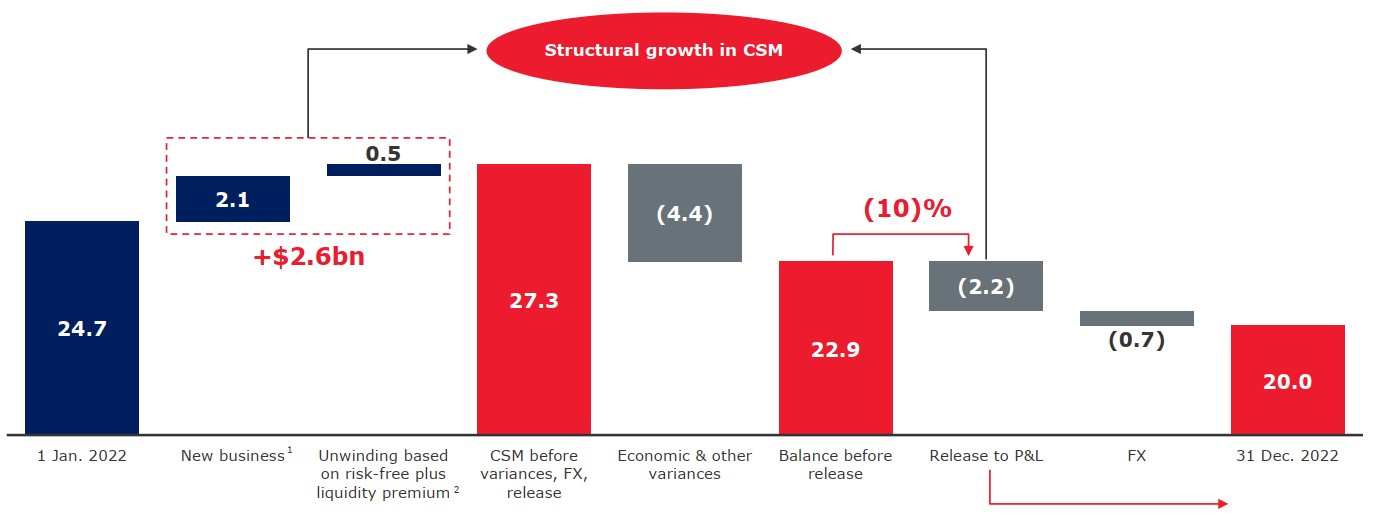
The release to P&L of the CSM is often the biggest item in the income statement, and this was the case for Prudential.
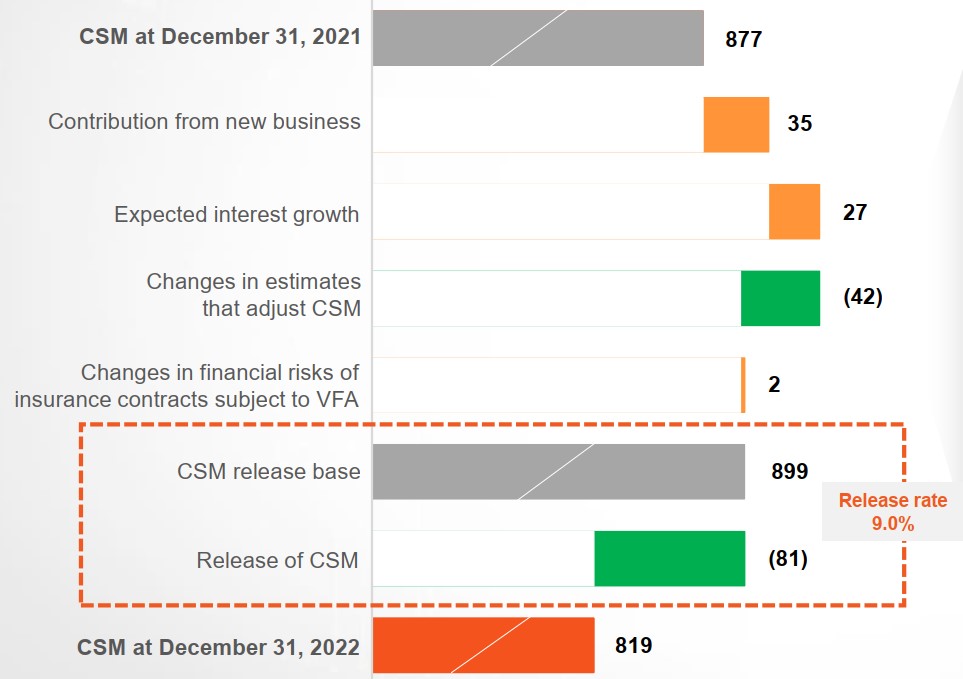
For Ping An the expected interest growth on the CSM was nearly the same size as the contribution from new business, with a negative impact from the changes in estimates that adjust CSM (changes in non-economic assumptions). Something which deserves further investigation is the release of CSM being greater than the contribution from new business, and end of year CSM being down on the CSM at the start of 2022.
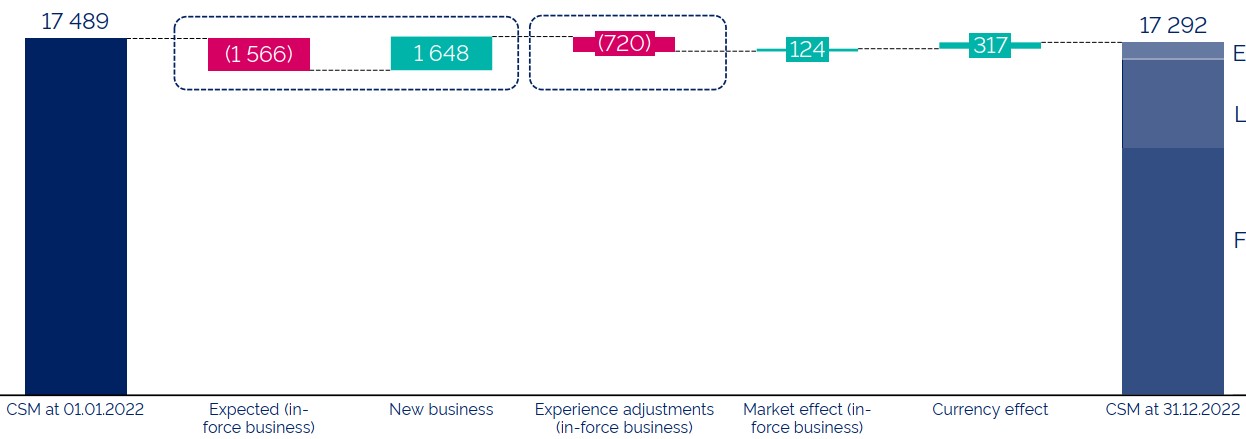
A healthy sign is that CNP Assurances saw their new business CSM exceeding the CSM allocated to insurance revenue based on coverage provided (1,566). " Non-recurring effects (-0.7bn) mainly concern France and correspond to (i) the effect of inflation on administrative and (ii) the adjustment of term creditor insurance surrender ratesThe market effect included in the CSM concerns the Savings/Pensions business and is neutral overall (+0.1bn), with positive effects in France and Latin America mitigated by negative effects in Europe excluding France."
For legal reasons please consider everything written on this website to be for entertainment purposes alone. It's vitally important to question everything and apply your own mind to anything you see or read.