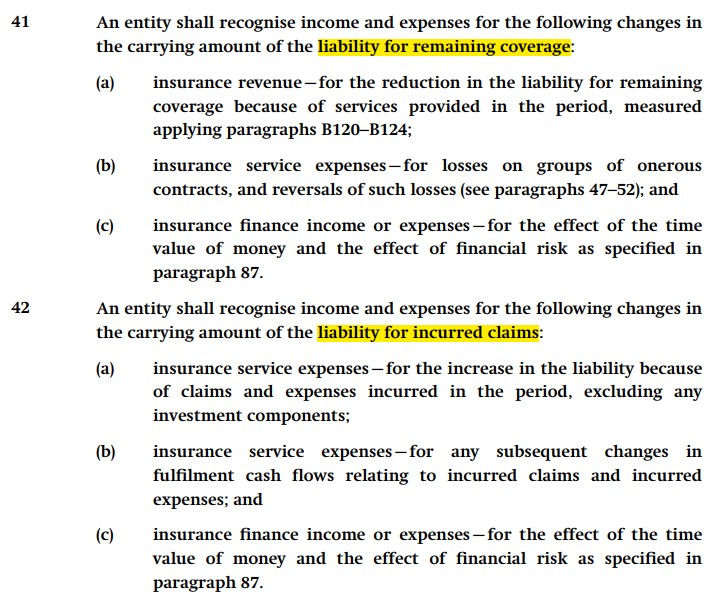
 IFRS 17 paragraphs 41 and 42 describe how changes in the Liability for Remaining Coverage (LFRC) and Liability for Incurred Claims are recognised in the various parts of the income statement:
IFRS 17 paragraphs 41 and 42 describe how changes in the Liability for Remaining Coverage (LFRC) and Liability for Incurred Claims are recognised in the various parts of the income statement:
The key to understanding the IFRS 17 insurance service result, is to understand how the following work:
There's often a massive reduction in the LFRC in the first year of an insurance contract due to the expected insurance acquisition cash flows being in that year. In order to avoid a massive amount of insurance revenue being recognised in the first year actual insurance acquisition cash flows runs through the revenue line as a negative (instead of through insurance service expenses), so we have the experience difference running through the insurance revenue:
The acqual insurance acquisition cash flows is then amortised over time :
Unlike the CSM which is recognised over the life of related insurance contracts, loss components are recognised immediately in insurance service expenses. For a group where there's a loss component; expected claims + expenses + risk adjustment is not equal to expected premiums; in fact it's greater than expected premiums by the amount of the initial loss component. So, to ensure that the release of expected claims + expenses + risk adjustment in insurance revenue equals expected premiums over the life of the policies, the initial loss component is amortised and:
Note that, as per IFRS17.41(b) "reversals of such losses" (not related to the amortisation) are recognised immediately in insurance service expenses.

The CSM release is relatively stable and predictable over time, with the proportion of the CSM released each year depending on coverage units provided in the year relative to total coverage units. For VFA business the CSM absorbs market movements.
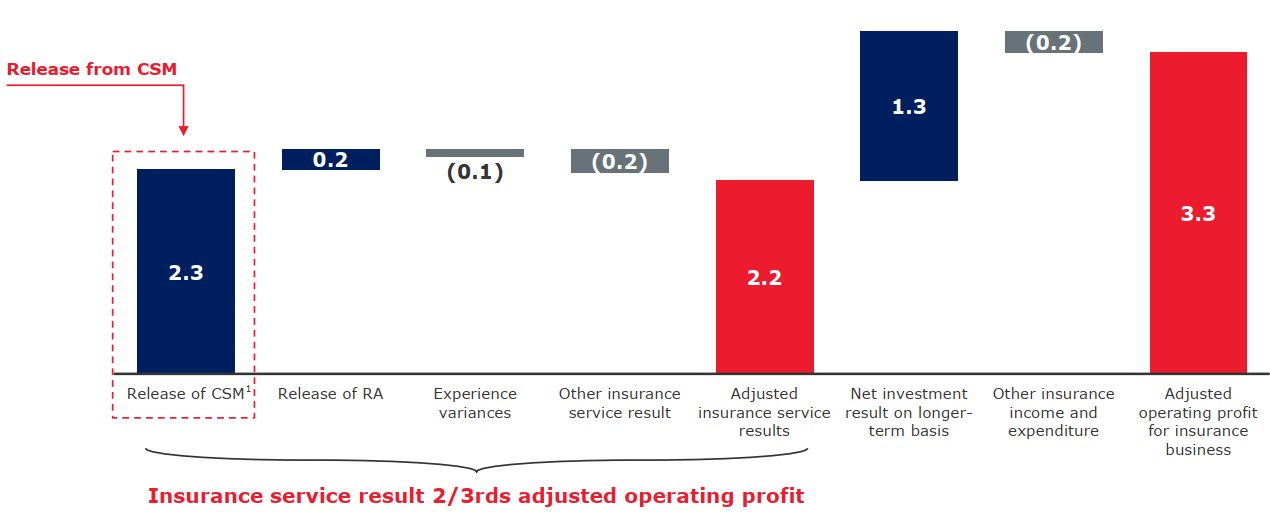
In this example, the 2022 adjusted operating profit was driven by the release of CSM and net investment result:
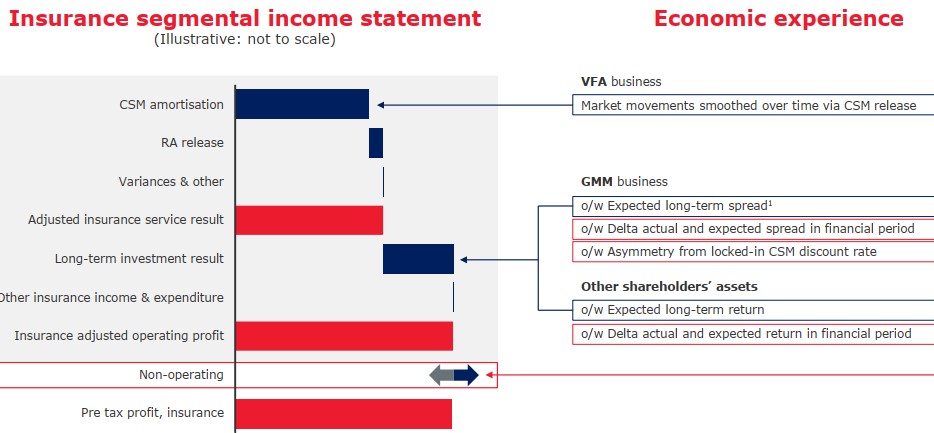 Prudential's CSM lies 72% in the VFA and 28% in the GMM:
We can see below how the Adjusted Operating profit for insurance is added into total segment profit, then non-attributable expenses are subtracted to arrive at "Group adjusted operating profit"; adjustments are then made for corporate transactions and tax to arrive at a loss after tax, and then adjustments are made for other comprehensive income; with the company confirming that all investment returns pass through the income statement. This statement relates to paragraphs 88, 89 and 90 of the IFRS17 standard. Paragraph 88 allows an accounting policy choice to be made between:
Paragraph 89 allows an accounting policy choice to be made for insurance contracts, with direct participation features, between:
Paragraph 90 says that if the accounting choices in 88(b) or 89(b) are taken, "it shall include in other comprehensive income the difference between the insurance finance income or expenses measured on the basis set out in those paragraphs and the total insurance finance income or expenses for the period."
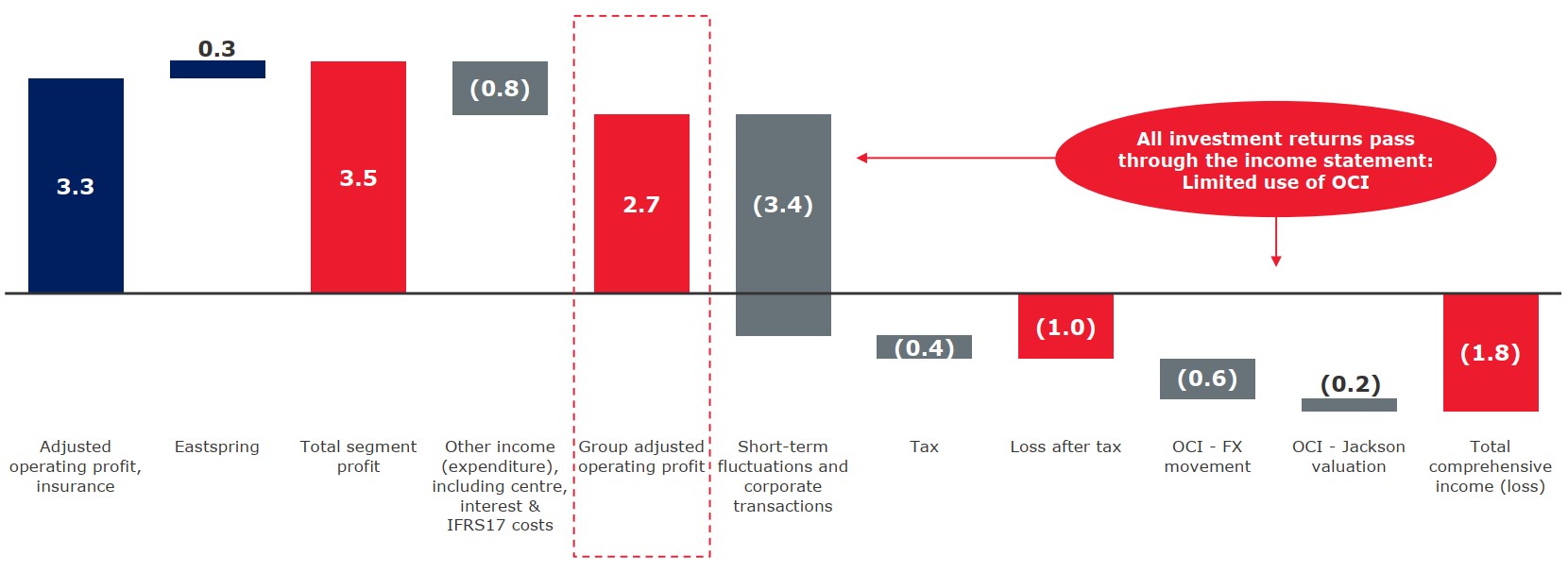
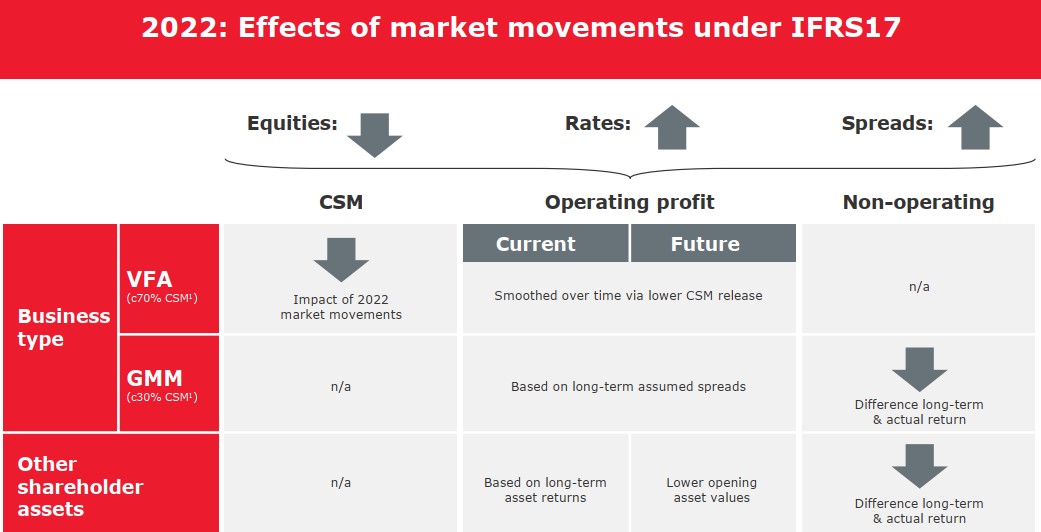
Adverse short-term fluctuations of $3.4 billion are recognised within the income statement. The non-operating income statement effect "is largely the true-up between the long-term investment spreads on GMM liabilities and the long-term returns on assets backing capital and equity assumed within our operating profit result and the actual realised returns earned in the year". IFRS17 is an active approach, which involves re-setting economic assumptions at the end of each period based on the actual government bond yields and corporate bond spreads. The large movement in 2022 was a result significant market movements, with interest rates up, credit spreads widening and equities down.
The image below summarises the impact of market movements on the 2022 income statement:
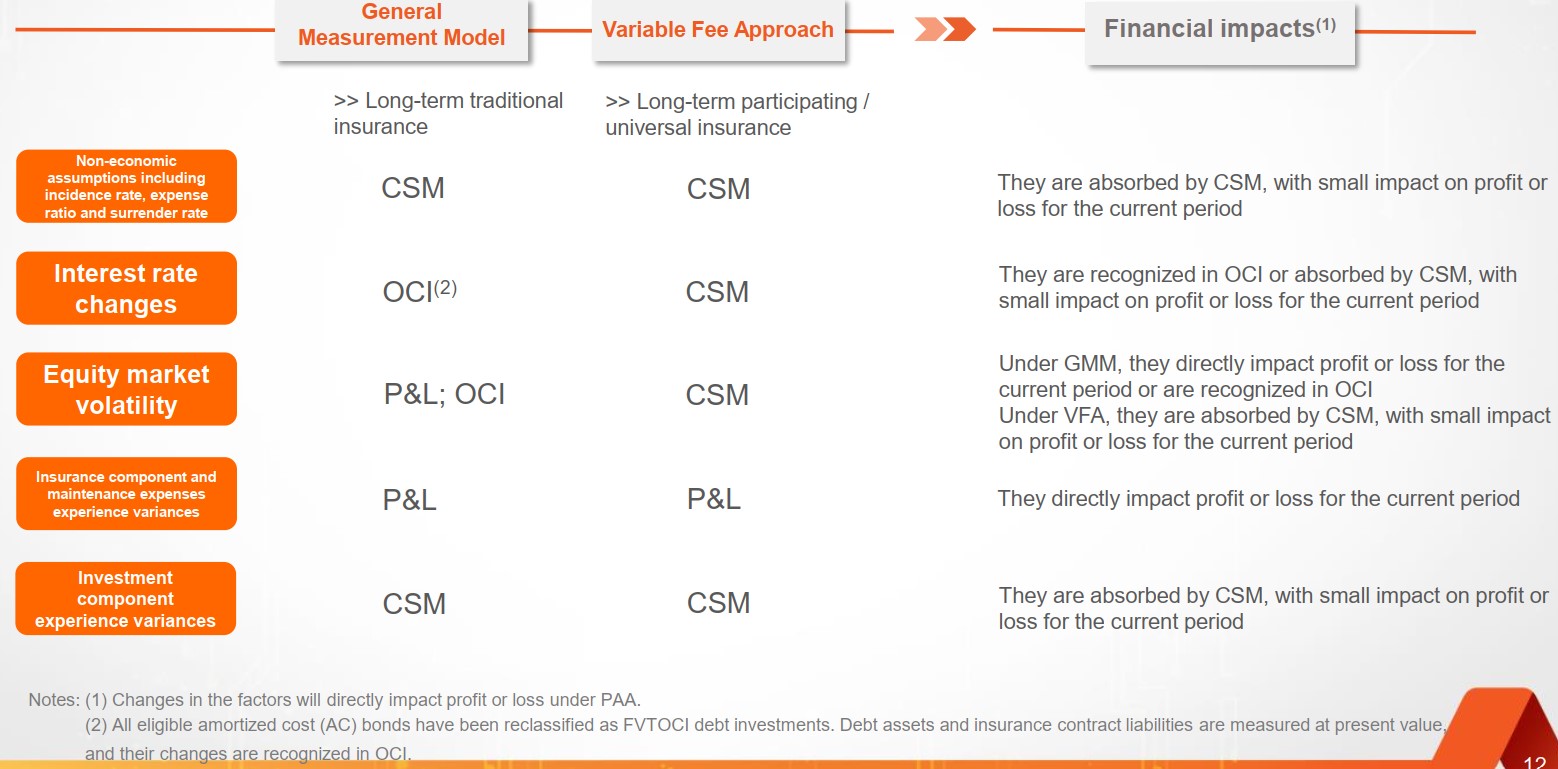
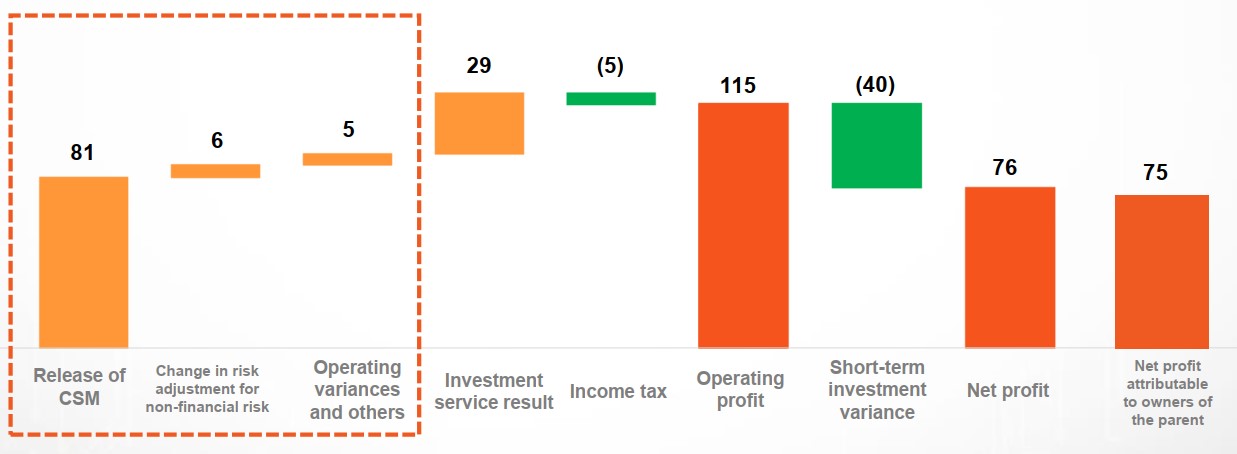
In the image below Ping An indicate that:
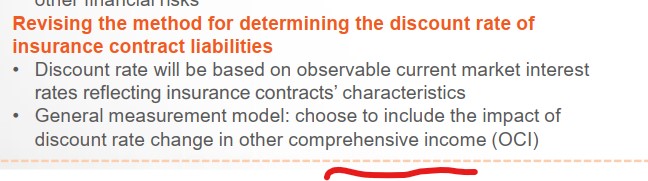 Here we can see :
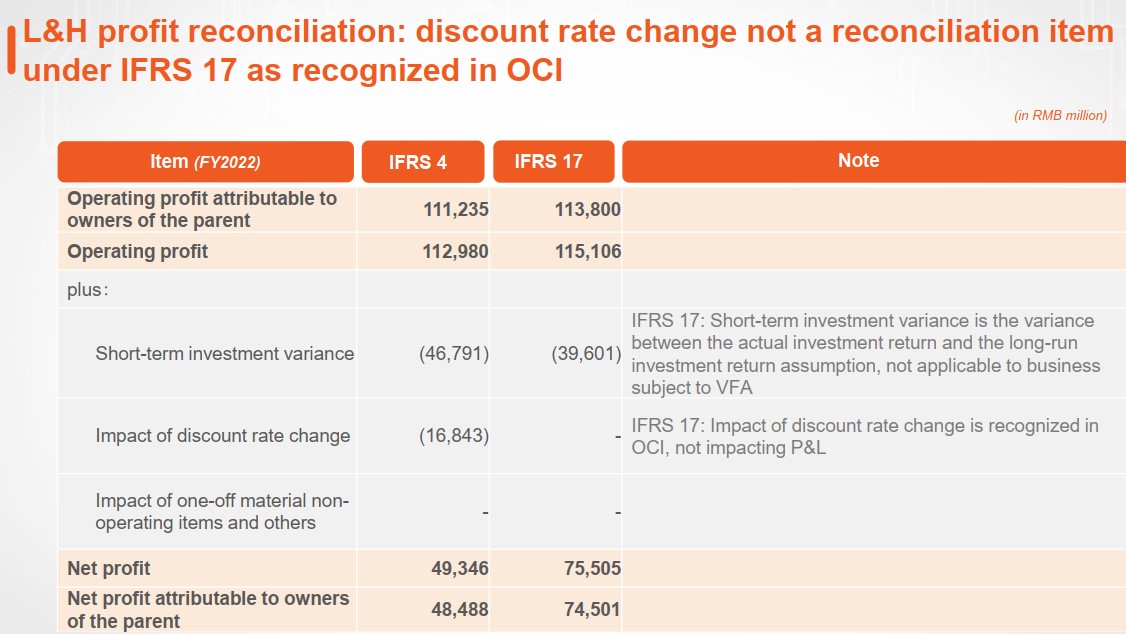
We can see that the main drivers of income for Ping An in 2022 were:
Release of CSM
Investment service result
Short-term investment variance
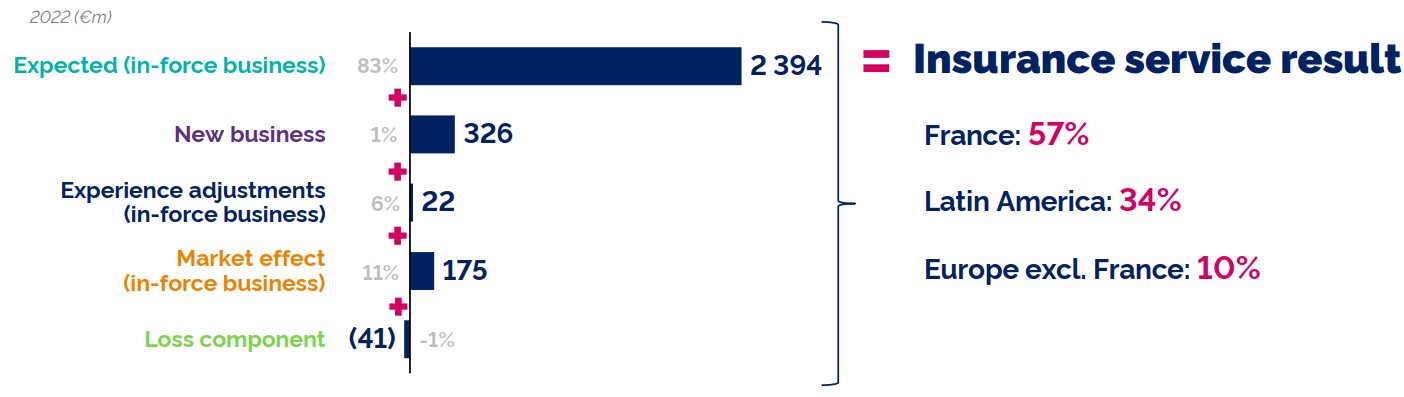
We can see how CNP Assurance's insurance service result is dominated by "Expected (in-force business)", which consists mostly of the CSM allocation according to coverage units released of business which was in-force on 1 Jan 2022, but also the release of the risk adjustment.
By comparison, the CSM and risk adjustment release for new business is relatively small, as are the market effect, loss component and experience adjustments.
The CSM spreads profit over time with unearned profit recorded as a liability that unwinds to profit as coverage is provided; excluding much of the CSM means that the insurance result may not give a good indication of the value generated during a period. Including the CSM (or more of it) may give a better indication of performance. As an example of post #IFRS17 performance reporting, Aviva calculates Operating value added (a non-IFRS measure) as follows:
(Operating value added) = (Operating profit) + (Operating change in CSM)

For legal reasons please consider everything written on this website to be for entertainment purposes alone. It's vitally important to question everything and apply your own mind to anything you see or read.